
Trauma Bonding
Entangled lives: My Brilliant Friend and Pachinko

Character, like a photograph, develops in darkness.
- Yousuf Karsh
Woe is me.
- You and I
The trauma narrative has become increasingly prevalent within popular culture.1 Originally conceived as a storytelling device to treat unprocessed psychological wounds, trauma narratives have (paradoxically) become a widespread source of mental injury.
We are all now said to live in the age of trauma. Trauma narratives are a prevailing tendency and social contagion. Their spread through social networks is symptomatic of a decreased ability to cope with adverse life events and/or a way of raising cultural capital.
Stories of suffering now function as a social cohesive or identity marker : they help delineate our boundaries or bond with one another over a perceived crisis.
Normal negative experiences - like failing a test, getting a flat tire or having our favorite television series cancelled - supposedly traumatize us or are inflated as traumatic events psychologically akin to (say) sexual assault or a death in the family.
Trauma narratives have therefore not only exposed us to increased stories of psychological harm but they have also lowered our tolerance or standards of what meaningfully constitutes suffering in the first place.
Specifically, an ever-increasing sensitivity (and receptivity) to perceived psychological harm is a default cultural response subject to memeification and competitive victimhood. 2
Trauma as trend or cultural narrative may therefore be considered a psychological risk factor or maladaptive coping strategy : we risk pathologizing normal emotional responses to adverse experiences and how we understand our own identities. The trauma narrative’s surprising inversion has paradoxically created a culture of morally virtuous victims. Trauma culture has made victimization a central part of our identities or moral virtue and undermined our ability to recover from (perceived) adversity.
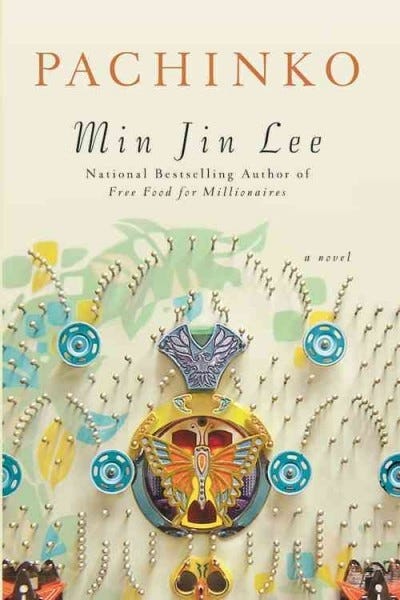
Two outstanding recent television adaptations, HBO’s My Brilliant Friend (from Elena Ferrante’s Neapolitan novel series) and Apple’s TV+’s Pachinko (from Min Jin Lee’s novel of the same name), both provide an antidote to dominant contemporary representations of trauma and return us to the notion of the trauma narrative as coping mechanism or strategy.
While the two television shows are very different, they may nonetheless be considered in parallel. The theme of boundary dissolution (an experience of self not being psychologically distinctive or delineated) is common to both narratives and explicitly thematized in My Brilliant Friend.3 These trauma narratives also emphasize the therapeutic value of psychological adaptation - specifically, of being able to adapt to environmental conditions or circumstances via the development of more functional traits and porous selves. The two series’ female characters survive misfortune and hardship because they refuse to see themselves as virtuous, helpless victims.
The narratives of My Brilliant Friend and Pachinko are instead sites of recovery and resilience, in that their female protagonists are characterized by their ability to withstand adversity and actively adapt to hostile social environments and situations.
Nonetheless, My Brilliant Friend and Pachinko are not so much narratives of triumph or uplift as tales of the difficulty of escaping cycles of abuse and oppression, and of the bonds that can be forged through shared traumas across generations.
A tangled knot
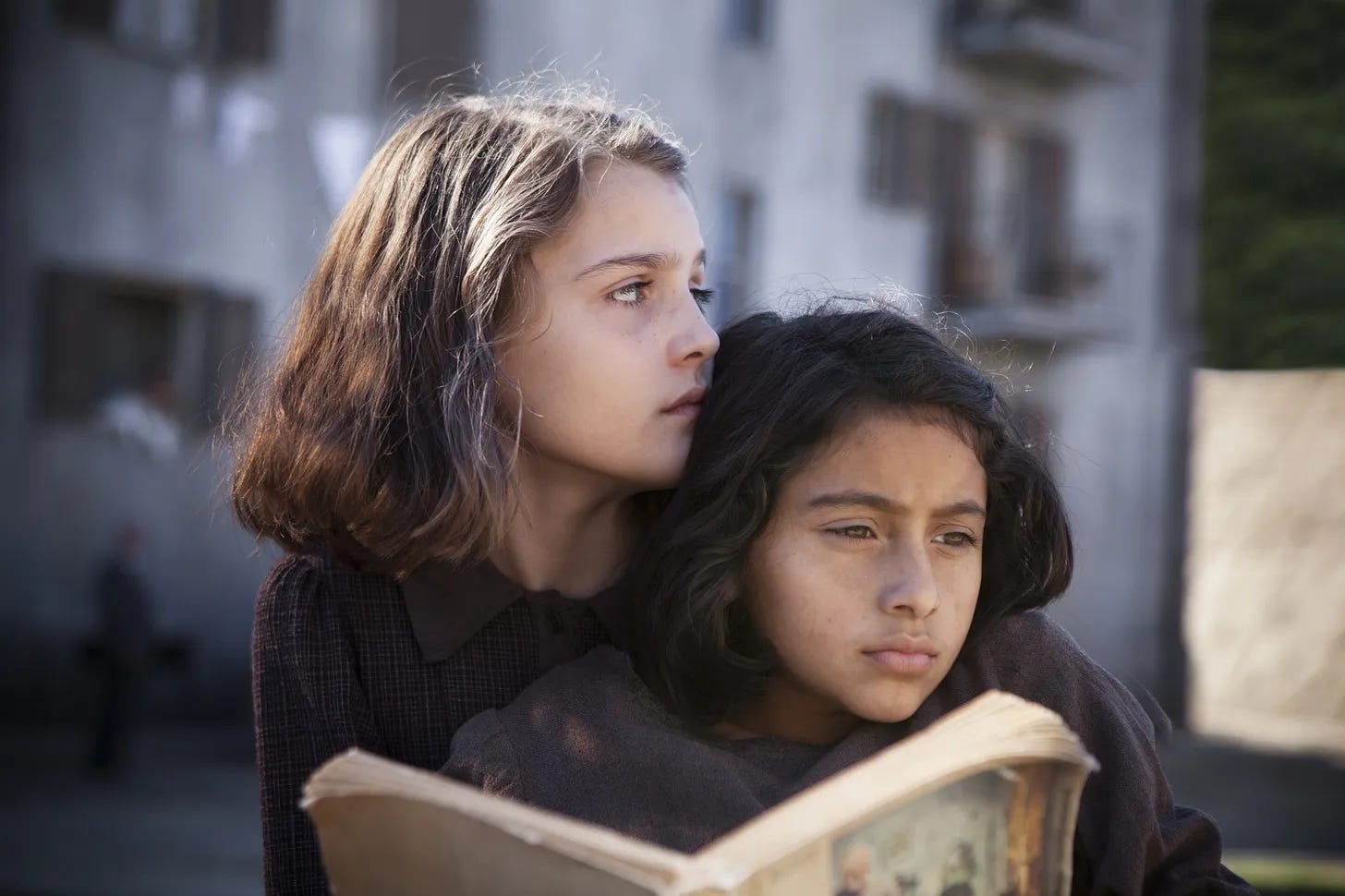
Narrated from the perspective of an elderly Italian woman called Elena (“Lenu”) Greco, My Brilliant Friend is structured as a flashback that unfolds chronologically over six decades, from the 1950s to the 2010s. Elena is played by multiple actresses across generations (Elisa del Genio and Ingrid del Genio as a child, Margherita Mazzucco as a teenager and young woman, Elisabetta De Palo in old age, and Alba Rohrwacher as a middle aged woman). As its title suggests, however, the series is about two women’s intertwined stories, or how Elena and her childhood friend Raffaella “Lila” Cerullo (played by Ludovica Nasti as a child, Gaia Girace in adolescence and young adulthood and Irene Maiorino as a middle aged woman) remain inexorably bound to each other in spite of their very different temperaments and trajectories.
Although the two main characters are portrayed by different actors across distinct life stages, it is their childhood, adolescent and adulthood experiences that figure most prominently in the first three (of four) seasons. The lower class neighborhood within Naples where they grow up will maintain a lifelong hold over both women, even if one of them is ultimately able to escape its proximate grip through higher education.

As the series progresses, we bear witness to what binds these two women together: the violent hierarchies and codes of male authority and desire.
Elena’s trauma narrative, however, begins with an instance of hermeneutic violence committed by a woman: the moral injury Elena will inflict on Raffaella (hereon referred to as Lila) by recounting the latter’s story without her knowledge or consent. Elena angrily refuses Lila’s express desire for erasure and takes it upon herself to speak for both of them.
After Lila does what she always threatened and mysteriously disappears, removing all traces of her existence in the process, Elena responds with an act of defiance and betrayal: unwilling to let her former best friend go, she spitefully attempts to preserve the memory of their friendship through the therapeutic process of storytelling.
As an angry Elena prepares to organize her thoughts and feelings, the spectral figure of a fearsome young Lila appears in her Turin apartment and looks at her accusingly across the boundaries of time. The little girl is defying the elderly woman to derive value or meaning from their shared life experiences.
So, even before we are taken back in time and the story proper begins, we are immediately alerted to the fact that My Brilliant Friend is not going to be an exercise in nostalgia or hagiography but, rather, an attempt at exorcising the demons that haunt two entangled women.
We are subsequently transported back to a classroom in elementary school. My Brilliant Friend thereby delineates its themes, characters and boundaries from the outset, brilliantly using the first-grade classroom to lay bare the hardships awaiting its protagonists. Class conflict and sexual inequalities are already writ large here: the classroom becomes a site of social competitiveness and gender hierarchy.
Social mobility is theoretically earned by moving up a class at school, but Elena and Lila quickly learn that any movement will be constrained by the unwritten rules of the two systems working to keep them down: patriarchy and capitalism.
Elena’s first rude awakening to this reality occurs when she is upstaged by Lila in class. As Elena is being publicly praised for having drawn neatly arranged lines, an unruly and dishevelled Lila draws adverse attention to herself by disrupting the class. When the teacher goes to punish the latter for another classroom transgression, however, she stumbles across an astonishing discovery: Lila has somehow taught herself to read and write.
Although Lila will prove to be equally brilliant at arithmetic and creative writing, she makes the mistake of beating the boys in a mathematics competition; as retribution, two sets of boys assault her, but she puts up a good fight in return and refuses to apologize for being smarter than them. This language of violence is shown to have been internalized and normalized by everyone in the neighborhood - including the women, who often take out their feelings of powerlessness and frustration on one another.
If a woman or child appears in public battered, bruised or bleeding, no-one appears to interpret this as a sign of domestic violence or physical assault; rather, such injuries are treated as marks of the victim’s own bad behavior, or evidence of a hard-learned lesson.
This ever-present threat of violence hangs over the entire neighborhood, and is used to keep everyone in place. The neighborhood patriarchal rule is nowhere better exemplified than by the two affluent and well-connected Solara brothers, Marcello (Elvis Esposito) and Michele (Alessio Gallo), who patrol the streets in their Fiat 1100 to kidnap poor young women and sexually assault them. An adolescent Lila appears to be the only young woman willing or able to take exception to their reign of terror, and threatens to cut Marcello’s throat when it’s Elena’s turn to ‘go for a drive’. Significantly, both brothers are attracted by Lila’s willingness to openly defy male authority, and seek to woo and pacify the seemingly intractable young woman with their local power and influence.
The blurring of lines between Elena and Lila - a difficulty in seeing where the one begins and the other ends - develops in childhood via transitional objects and experiences. The young girls test the limits of their developing bond to one another by swapping each other’s attachment figures - their cherished dolls Tina and Nu - and throw them into a mafiosa’s dark cellar.

When the girls fail to find their projective play figures, a fearless Lila is somehow able to ‘extort’ the local Don for money as compensation. Lila will go on to buy a copy of Little Women for both of them instead.
The two girls bond further reading Little Women, and Alcott’s timeless classic inspires the precocious Lila to write her own novel for Elena to read.
Their seeming loss of discrete identity establishes a mutually dysfunctional attachment style, making it increasingly difficult for each character to delineate their sense of self; they will continue to test the limits of their friendship in order to establish contested boundary lines and identities.
Indeed, their roles are subsequently reversed when Elena inadvertently becomes the brilliant friend (and famed writer) by being allowed to continue her education without Lila. These two life events become blurred and formative: they appear to have also exchanged lives, and will go on to live vicariously through one another.
One of My Brilliant Friend’s most distressing scenes occurs when Lila is denied the opportunity to proceed on to middle school with Elena: after Lila refuses to take no for an answer, her father, Fernando (Antonio Buonanno), angrily throws her out of a window and onto the street below. The scene is not only a shocking act of domestic violence, it is arguably attempted murder : her father is disappointed to see that his young daughter has somehow survived the fall.
During her flight towards the asphalt, Lila starts to experience the sensation of dissolving boundaries - a dissociative state that begins as a self-protective measure and eventually culminates in episodes of terror throughout adulthood.
As the first novel observes
The day her father threw her out the window she had felt absolutely certain, as she was flying toward the asphalt, that small, very friendly reddish animals were dissolving the composition of the street, transforming it into a smooth, soft material.
She had often had the sensation of moving for a few fractions of a second into a person or a thing or a number or a syllable, violating its edges… (And as a young woman) she had perceived for the first time unknown entities that broke down the outline of the world and demonstrated its terrifying nature (p.91).
Nonetheless, Lila withstands most of life’s hardships through sheer defiance and willpower. As a consequence, the men in Lila’s life will become intent on violating her edges or breaking her down in order to improve their own social standing.
Although Elena acquires cultural capital through education, her book smarts fail to confer the same social status or value afforded by Lila’s physical beauty. Considered ‘the pretty one’ in earlier life, Elena feels eclipsed once more when Lila transforms into a beautiful young woman and men start competing for her attention - including the opportunistic and predatory social climber Nino Sarratore (portrayed by Alessandro Nardi, Francesco Serpico and Fabrizio Gifuni across generations), Elena’s object of desire and future husband, with whom an unhappily married Lila has an affair (and possible child) years prior.
As a consequence of leaving her abusive husband, Stefano (Giovanni Amura), and apparently having a child out of wedlock, Lila is treated as a fallen woman - only to be left in turn by Nino, who seeks refuge in more compliant and socially advantageous women. And although Elena’s upward mobility coincides with Lila’s downfall, her movements within a socially stratified society do not secure her a happy marriage either; she ends up sabotaging her first marriage with academic Pietro (Matteo Cecchi) through her own affair with Nino, abandoning her children to be with him.
The two different women cheat on their husbands - and, in a sense, on one another - with this same man for similar reasons. Lila is primarily valued for her beauty, and is treated as a mere conquest or trophy wife. She is regularly subjected to marital rape, and is only able to exit her gilded cage by temporarily returning to a life of poverty and ill repute. Lila’s resilience, resourcefulness and shamelessness will, nonetheless, remain her saving grace: no man will be able to hold her down and she will go on to succeed on her own terms regardless.
Elena, meanwhile, discovers that access to education can only take her so far in a patriarchal society, merely leading to oppression within a higher social class; apparently having been chosen solely for her ability to produce intelligent offspring, she is expected to prioritize child-rearing over her own ambitions and goals. The irony (or implicit tragedy) is that Elena’s marriage to Pietro only produces intelligent daughters anyway - and so (despite their genetic inheritance and opportunities for social advancement through education) will be fated to similarly experience female oppression.
For both women, the narcissistic Nino provides an illusory opportunity to escape themselves, each other and their oppressive social bonds. Their experience of falling in love with him enables a dissolution of boundaries - the possibility of merging with another person in order to become completely lost in someone capable of only loving themselves.
These events occur against a carefully calibrated and interrogated social milieu, and the two women’s characters develop within the darkroom of history - specifically, Italy’s Years of Lead, a two-decade period of social upheaval that often erupted in episodes of terrorism and continues to cast a long shadow. An increasingly terrorized and traumatized nation thus under girds Elena and Lila’s shared experience of dissolving boundaries.
During the insufferable final season, it is the audience who will be traumatized. From one episode to the next, the highly intelligent Elena chooses to act against her better judgement or best interests. Elena Ferrante somewhat perversely allows the audience to see something that the other Elena refuses to: that her relationship with the married Nino is based on wilful obfuscation and threatens all her other relationships and obligations (as a mother, daughter and friend). Her love affair with the self regarding Lothario dissolves into self-sabotage. My Brilliant Friend tests viewers loyalties and sympathies accordingly.
My Brilliant Friend goes to great lengths to dramatize the ways love makes fools of us all. The series belabors this theme mercilessly, and audiences will find themselves increasingly alarmed - and feeling similarly powerless or foolish - by Elena’s seemingly irrational, selfish and shameless behavior as an adult woman.4 My Brilliant Friend thereby tests gender norms or assumptions in the process: would viewers be similarly traumatized by such reckless abandon if Elena were a man, or if we could see her affair through a male’s eyes?
My Brilliant Friend culminates in a genuinely traumatic event : the mysterious disappearance of a child. Lila’s daughter Tina goes missing, and is never seen again. The issue of Tina’s fate or whereabouts remains unresolved. Ferrante withholds the consolation of closure in a narrative or psychological sense . A child’s disappearance is (of course) every mothers’ worst nightmare, and will push Lila over the edge. The child’s disappearance will also drive a wedge between Lila and Elena, and their relationship will never be the same again.
The narrative’s openness makes little attempt to console or reassure us either, and the question of Tina’s fate - was she kidnapped and murdered, did she run away from home, etc? - rubs salt into a gaping wound. One possibility - likelihood - is particularly traumatic.
Specifically, Elena’s writing was drawing adverse attention to organized criminal activity within the neighborhood, and it is possible that the wrong child was kidnapped and murdered as a punishment or warning to her. Lending credence to speculation about a case of mistaken and/or stolen identity : Lila was carrying Elena’s youngest child at the time Tina went missing, and Tina had previously been photographed with Elena in a newspaper article and misidentified as her child because she was prettier than her own child.
Thematically speaking, the possibility of a ‘child swap’ makes the most sense. The blurring of lines between Elena and Lila means that they have also appeared to exchange fates again, and a punishment (or warning) intended for Elena was doled out to Lila instead.
When all is said and done, the long-suffering (and long-gone) Lila gets to have the last say when she sends Elena a traumatic message in the form of a recovered childhood memory. The mystery reappearance of comfort objects reframes their entire relationship (transition through or attachment to) one another.
We have been led to believe that Lila was a ‘supporting’ character in Elena’s narrative. Lila’s parting gift, however, threatens to displace Elena to the margins of her own life story. Lila’s unsettling message intimates that she might have been the main character in Elena’s story from childhood onward, and had been controlling the narrative of My Brilliant Friend through a side or supporting character called Elena: had the thwarted writer toyed with Elena as if she were a projective play figure too?
Given the nature of the friends’ lifelong entwinement, the difficulty is determining who might really be the author or projection of My Brilliant Friend is to be treated as a distinction without a difference anyway.
Either way, it will be Elena’s trauma narrative that is placed under erasure, calling into question the therapeutic value of her own remembrances of things past.
Ties That Bind
History has failed us, but no matter.
— Min Jin Lee, Pachinko
My Brilliant Friend and Pachinko may be worlds apart, but they share a distinct worldview: women are treated more harshly for crossing social boundaries, and suffering is a thread that often binds women together. Pachinko’s characters will also develop within the dark room of history, and the series will go on to explore the fall out of many traumatic events, including colonial rule, natural disaster and nuclear warfare.
The main difference between My Brilliant Friend and Pachinko is cultural, or the ways each views and explores the lived experience of historized identities. My Brilliant Friend and Pachinko focus on the themes of individualism and collectivism respectively.
Specifically, My Brilliant Friend complicates the Western embrace of autonomy and/or individuality, while Pachinko prioritizes the Eastern tendency towards group cohesion and interdependence.
Pachinko thereby explores the way shame acts as a cultural imperative or orientation across distinct Asian cultures (Korea and Japan) and generations. The Encyclopedia of Psychology explains shame cultures in the following way
Shame culture is fundamentally understood as an organizing principle within a society where the paramount driving force is the preservation of external honor and the rigorous avoidance of public shame. This cultural orientation dictates that moral behavior is primarily regulated by the perceived judgment of the community, rather than by a deeply internalized sense of transgression or wrongdoing. In essence, the locus of moral authority resides outside the individual, resting firmly within the collective social structure.
The maintenance of social standing, both for the individual and their immediate kin, becomes the highest behavioral priority, influencing everything from vocational choices and marriage arrangements to daily interactions. This system reinforces a profound sensitivity to reputation, where the failure to meet societal expectations is not merely a personal failing but a visible stain upon the entire family unit.
Consequently, My Brilliant Friend and Pachinko capture qualitatively distinct experiences of one or more characters’ ‘outline of the world’ (p.76) breaking down as they all seek ‘a structure [...] capable of containing’ (p.624) in its entirety their fractured or displaced sense of self across generations.5
Pachinko is distinguished by a narrative built around an experience of cultural erasure and inter-generational trauma. The source of this trauma is history itself: Japan’s annexation of the Korean peninsula in 1910 and Korean women’s subsequent experiences of diasporic existence within an antipathetic and discriminatory Japan.
As the novel observes, ‘history has failed’ its Korean characters. Japanese annexation - and the subsequent dispersion of Koreans - forcibly dissolved their experience of culturally bounded or delineated identities. Racial discrimination, an ethnic hierarchy and economic exploitation had become a structural feature of the empire subsuming Korean men and women.
Nonetheless, Pachinko is living testament to those Koreans who have endured in Japan (where they are known as zainichi ) despite their erasure from the historical record.
Pachinko’s central figure is the displaced Sunja, whom we see across distinct life stages: as a hopeful little girl (Jeon Yu-na) with her whole life ahead of her; as a young adult immigrant (Kim Min-ha) seeking to improve her fortune in Japan; and as a long-suffering elderly widow (Youn Yuh-jung) looking back on her life with joy and sorrow.
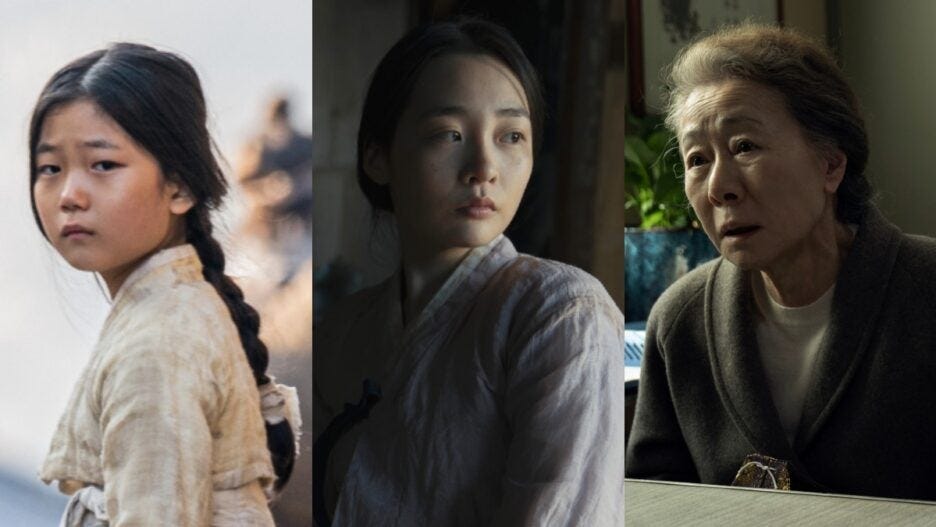
Sunja across the ages
Sunja provides a through line that spans eight decades, three nations (Korea, Japan and the United States) and four generations in her search for a sense of place and unifying identity. This shared feeling of displacement itself paradoxically becomes a marker of cultural identity and remains an integral part of Sunja’s inheritance; the traumatic experience of boundary dissolution is passed down from generation to generation, providing its own sense of continuity or culturally bounded identity.
While Lee’s novel and its screen adaptation share many of the same outlines in terms of their world-building, it is worth noting that the television series (in its first two of projected - but increasingly unlikely - four seasons)6 takes a different approach to the theme of boundary dissolution.
Specifically, the novel unfolds chronologically, and its organizing principle is an experience of being temporal or bounded in time - via the linear progression of past, present and future - as the randomness of events accrues historical import and meaning.
The television series changes this sense of accrued meaning by dissolving temporal, spatial and psychological boundaries: it moves back and forth in time so that past, present and future can enter into a meaningful dialogue with one another.
Consequently, a relatively minor male character in the novel - Sunja’s Yale-educated grandson Solomon (played by Yoon Kyung-ho as a teenager and Jin Ha as an adult) - is given more prominence and historical precedence. The attempt to facilitate a dialogue between discrete time periods also results in a dissolving of boundaries between ‘female’ and ‘male’ perspectives in Pachinko’s treatment of inter generational trauma.
This lived experience of boundary dissolution is perfectly encapsulated in the first episode’s remarkable eight-minute opening scene.
Pachinko’s editing deploys the first of many dissolves and cuts to transition between seemingly disparate sequences, periods and sensibilities. It begins with Sunja’s pregnant mother, Yangin (Jeong In-ji), visiting a shaman in a pastoral Korean setting in 1915.
She is lamenting the ‘curse in [her] blood’; fearful that she might lose another child, she hopes that the spirit world of her ancestors will intervene to preserve a seemingly accursed bloodline.
We suddenly transition to a young Korean man, Solomon Baek - a fast-rising investment banker whose bubble is about to burst - striding through New York’s skyscrapers in 1989. After he is denied a promised promotion in the Western world, we immediately cut back to Yangin’s time and place in Korea to witness a dance ritual intended to lift the family curse, before returning once more to New York as Solomon convinces his bosses to let him go to Tokyo to finally prove his worth to them.
And then we’re back in Korea again, with the shaman declaring, ‘A child is coming. She will thrive, I assure you. And through her, a family will endure.’ The scene is written and shot as if Solomon’s pitch in the future has a rallying-around-the-flag effect in the past. It looks like Sunja’s grandson is literally calling his grandmother into being in order to secure his family’s lineage and legacy.
At the time of Sunja’s birth, Japan has already colonized and plundered a publicly shamed Korea. A cherished only child, she is made a solemn vow by her over-protective father Hoonie (Lee Dae-ho) that he cannot keep: to ‘ward off all the ugliness in the world and keep it far away from you’. Her father - a stigmatized man ‘born with a cleft palate and a twisted foot’ - also promises to show her that ‘there is such a thing as kindness in this world’.
Unfortunately, when Sunja is thirteen, fate cruelly intervenes again and tuberculosis takes him away from her - her first of many genuinely traumatic experiences.
The second comes in the form of a handsome man old enough to be her father, Hansu (Lee Min-ho), to whom a vulnerable teenage Sunja soon falls pregnant. She is shocked to discover that the shameless Japanese collaborator with ties to organized crime is also a married man, and that he can only offer her a life as a kept mistress.
Although Hansu and Sunju attempt to be discrete, anyone with a pair of eyes can see what has been going on between them. There will be a point where they will not be able to conceal her pregnancy or their illicit relationship - and this ‘open secret’ will only harm her reputation. Having enough self-respect to decline Hansu’s ‘kind’ offer of support and protection, Sunja decides to bear her private shame alone too.
Happenstance brings a kindly if sickly minister, Isak Baek (Steve Sang-hyun Noh), to her distraught mother’s boarding house, and, after both women nurse the dying man back to health, he takes it upon himself to propose to the pregnant Sunja and raise another man’s child as his own.
The recovered minister, however, is only passing through, and the newly married couple must leave for Japan - where they (alongside many other Korean immigrants seeking a better life) become second-class citizens in a discriminatory and oppressive society.
On the other side of the century, Solomon is trying to secure an important real-estate deal for the Tokyo branch of his financial institution. The property’s elderly Korean owner, however, is too proud to sell another part of herself to the Japanese, and Solomon finds himself subjected to racial prejudice on both sides of the cultural divide. Enlisting his grandmother to help him close the deal, the increasingly Westernized Solomon unexpectedly finds himself wondering where his own loyalties lie.
By this stage, we’ve also entered the pachinko parlor operated by his father - and Sunja’s younger son - Mozasu (Soji Arai): a site of semi legalized gambling with historical links to organized crime. Mozasu has grown rich trading in luck and occupying a morally grey area. Further, the titular Japanese arcade game - a mixture of pinball and slot machines - has paid for his son’s Ivy League education and paved the way for displaced Koreans to live the American dream vicariously through one of their descendants.
The rigged pachinko machines are also clearly a metaphor for life: life as slot machine, or of being propelled by the unpredictable forces of chance and ricocheting off the bumpers in the hope of altering life’s preordained trajectories.
Given Pachinko’s intertwined stories and characters, its narrative resists straightforward encapsulation. Its interweaving of story lines and timelines explores the different ways the series’ characters carry the weight of history, as well as how their actions reverberate across time and affect one another.
The arc of Pachinko’s history bends towards psychological resilience and an inter-connectedness between increasingly adaptable and indebted people. Its exploration of boundary dissolution is also, paradoxically, enclosed within the cultural phenomenon of pachinko, with the ubiquitous arcade game having served to not only bring Japanese and Korean people together but also undergirds a sense of community and belonging within Japan for the (predominantly) Korean owners of these parlors.
Social marginalization has, ironically, proven to be socially advantageous for some Koreans; because they were denied legal access to other opportunities and occupations, members of the minority group were able to corner a niche and burgeoning market - effectively gaming the system working against them by inhabiting a moral grey area.7
The family’s change in fortunes comes from occupying a complex historical space: one where moral, legal and cultural boundaries dissolve into or permeate one another. Despite many hints and intimations, Pachinko leaves the story of increasingly blurred or opaque lines for unlikely to eventuate seasons.
The series premature cancellation means that ‘traumatized’ viewers will now be required to read the book for psychological and/or narrative closure.
Nonetheless, a preview is provided in the series’ opening credits through a dazzling dance sequence set in a pachinko parlor. Here, all versions of Sunja occupy the same time and place as the family celebrate her legacy, offering an expression of resolute gratitude and an exhortation to live in the present moment and sharing a love that has no bounds.
The two seasons’ sequences begin with sombre archival footage of Japanese colonization and occupation before bursting into a colourful dance sequence soundtracked by The Grass Roots’ Let’s Live for Today (season 1 ) and Wait A Million Years (season 2 intro)
During the course of two seasons, Sunja’s two sons will find themselves (independently) working in pachinko parlors for different reasons. A shared family history will propel them along distinct life trajectories.
The one (Isak’s son Mozasu) will proudly embrace his Korean identity and heritage and go on to increase his family’s social standing in Japan as a zainichi.
The other (Hansu’s son Noa) will invariably take on a false Japanese name and identity to conceal his private shame or disgrace. Significantly, Noa does not appear in any of the show’s ‘future’ scenes - the ‘lost child’ appears to have completely dissolved into Pachinko’s margins.
Noa’s mysterious disappearance will leave Sunja feeling inexpressible shame and grief. 8 The still hopeful elderly woman, however, remains capable of developing a friendship with a kindly Japanese retiree Kato Tatsumi (Jun Kunimura) many years later. Although Sunju’s husband Isak died a premature death many years earlier (1945), his initial act of kindness remains the thread binding the Korean family together in Japan.
Honouring the Baek name (or memory) is the way Sunja’s bloodline endures across generations and cultures. Indeed, the novel ends with Sanju paying her respects at Isak’s grave in 1989, and she is last seen talking about the child that had lost his way. Isak might have crossed over to the other side, and Noa placed himself under erasure, but Sunja remains bound to both of them.
Pachinko’s first season culminates in an empowering dissolution of cultural boundaries: Sunja’s act of culinary diplomacy, an age-old means of improving social relations through the universal language of food. Sunja instinctively understood
the importance of commensality to create commonality — that is, sharing a meal with either friends or enemies can (also) serve to strengthen ties and reduce antagonism… The use of food and cuisine can be an instrument to create cross-cultural understanding in the hope of improving interactions and cooperation.
Indeed, when all hope appears to be lost, a younger, destitute Sunja rises to the occasion of supporting her family in the past by reinforcing her historical connection to the motherland. Having been treated with hostility and banished to the margins in a foreign country, she is unexpectedly assisted by a kindly Japanese street vendor, who allows her to set up a small kimchi stall beside him.
This random act of generosity creates a social space for our resident zainichi, reminding her that kindness can exist in unexpected or hostile places - just as her father assured her. Although an overwhelmed Sunja briefly dissociates in this moment, she fortifies herself by reconnecting to her cultural identity. As she dissolves into the boundaries of a crowded marketplace, she can be heard inviting Japanese passers-by to come taste her ‘mother’s special kimchi recipe’.
Una versione di questo articolo apparve originariamente sul ormai defunto Metro 214. 이후 개정, 업데이트, 그리고 다음과 같은 상태로 전환되었습니다 鏡の国の
The term trauma bonding typically refers to the emotional attachment between abuser and victim, and is characterized by a vicious cycle, or cycles of negative and positive reinforcement. Although it is arguable that we are using the popular culture understanding of the term here - where people bond over their shared stories of perceived trauma - part of our aim is to argue that the relationships explored in My Brilliant Friend and Pachinko are similarly subjected to cycles. The question is the nature of the vicious cycle and where to locate the respective cycle’s momentum or trajectory (between best friends and/or distinct social groups).
The trauma narrative’s inversion is not without cultural significance and worth delineating in advance of our discussion of two narratives structured around trauma bonding.
Specifically,
The narratives were originally a way to ameliorate a traumatic response to distressing (overwhelming and/or inexpressible) events. Trauma narratives attempted to create order and meaning in two distinct but related ways: via a form of exposure therapy (breaking a repression-avoidance cycle) and through the therapeutic process of storytelling (an organized framework enabling access-expression of yet to be integrated feelings). The treatments thereby exposed traumatized individuals to painful thoughts and feelings in a relatively safe (controlled and regulated) environment in order to integrate them into a personal narrative.
The trauma narrative has since become a destabilizing social contagion spreading through inter group contact and social media. The narratives have not only exposed people to stories of psychological harm but they have lowered our tolerance or standards of what meaningfully constitutes suffering in the first place. Instead of building resilience or enabling (positive) adaptation to changes and challenges, the stories we are willing to tell ourselves and each other are making us more susceptible to vulnerabilities or feelings of helplessness and victimhood. As importantly, they have resulted in the trading and/or evaluation of cultural capital and/or group identity - where suffering itself becomes the currency subject to (re)evaluation. Trauma narratives have thereby become a way of ranking individuals and groups according to perceived harm, virtue and/or impotence competing for (say) more attention, sympathy and power.
The term ‘dissolving boundaries’ - also the title of Episode 4 of Season 1 - is explicitly used by Ferrante to describe psychic disturbances in Lila. See, for instance, Elena Ferrante, The Story of the Lost Child, trans. Ann Goldstein, Text Publishing, Melbourne, 2015, p. 371.
Significantly, this theme recurs in an adaptation of another Ferrante novel, The Lost Daughter (Maggie Gyllenhaal, 2021): the film’s protagonist, Leda (Olivia Colman), is an academic who has similarly abandoned her children in order to have an affair with another dickhead. Many years later, she disrupts a mother-child bond by developing a seemingly perverse attachment to a distraught child’s doll and stealing it for herself.
To quote Ferrante and not Min Jin Lee here.
There have only been two seasons, and the expensive (and apparently low rating) series is yet to be renewed for a third season. It is safe to assume that (unlike My Brilliant Friend) the Pachinko adaptation will not come to full fruition. It is arguable that a perceived dip in quality between season 1 and 2 contributed to the lower ratings and/or failure of renewal - and this might be attributable to controversial changes taken with Min Lee’s international best selling novel.
Although gambling is illegal in Japan, pachinko parlors have been able to navigate a legal loophole by rewarding winners with tokens that can be sold for cash at exchange centers outside.
We have blurred the boundaries here. In the novel, Sunja will find her lost child (via Hansu) many years later and he is living a life of quiet desperation. Noa lives in perpetual shame as an adult and is doing his best to remain dissolved or invisible. Although he has managed to ‘pass’ for a respectable Japanese person (manager, husband, father), he is nonetheless living in fear of being found out or ‘outed’ by both families. When a delighted Sunja briefly gets to meet her missing son again, he promises her a family reunion before quickly ushering her out of his office. Noa will nonetheless takes his own life as soon as she leaves - creating its own cycle of negative self-evaluative feelings across culturally distinct shame cultures.